Fight Forward, Control the Center, or Face the Fall.
SUJU MMA is a new, spectator-first combat sport that removes the cage and rewires how a round unfolds: you start in a grappling-driven battle for center control, and the moment a fighter gets forced out of the center ring (or taken down), the fight changes state—striking opens, momentum swings, and the bout becomes a different kind of problem to solve in real time.
If you’re a fighter, coach, or gym owner, the easiest way to understand SUJU MMA is to think of it as a two-phase loop:
1) Center battle (faceoff rules) → 2) Ring-out / takedown trigger → 3) Strikes activate + points + resets → and the cycle repeats.
That loop is the whole identity of the sport.
The Start Phase: A Grappling-Driven Fight for the Center
Every round begins with a faceoff inside the center ring at marked lines. The initial goal is simple: push, pull, or throw your opponent out of the center ring, or score a takedown. The referee initiates the round with commands, “Ready” then “Go.”
During this opening phase, SUJU MMA intentionally keeps the rule-set tight:
- No strikes allowed during the faceoff (but open-hand thrusts are permitted)
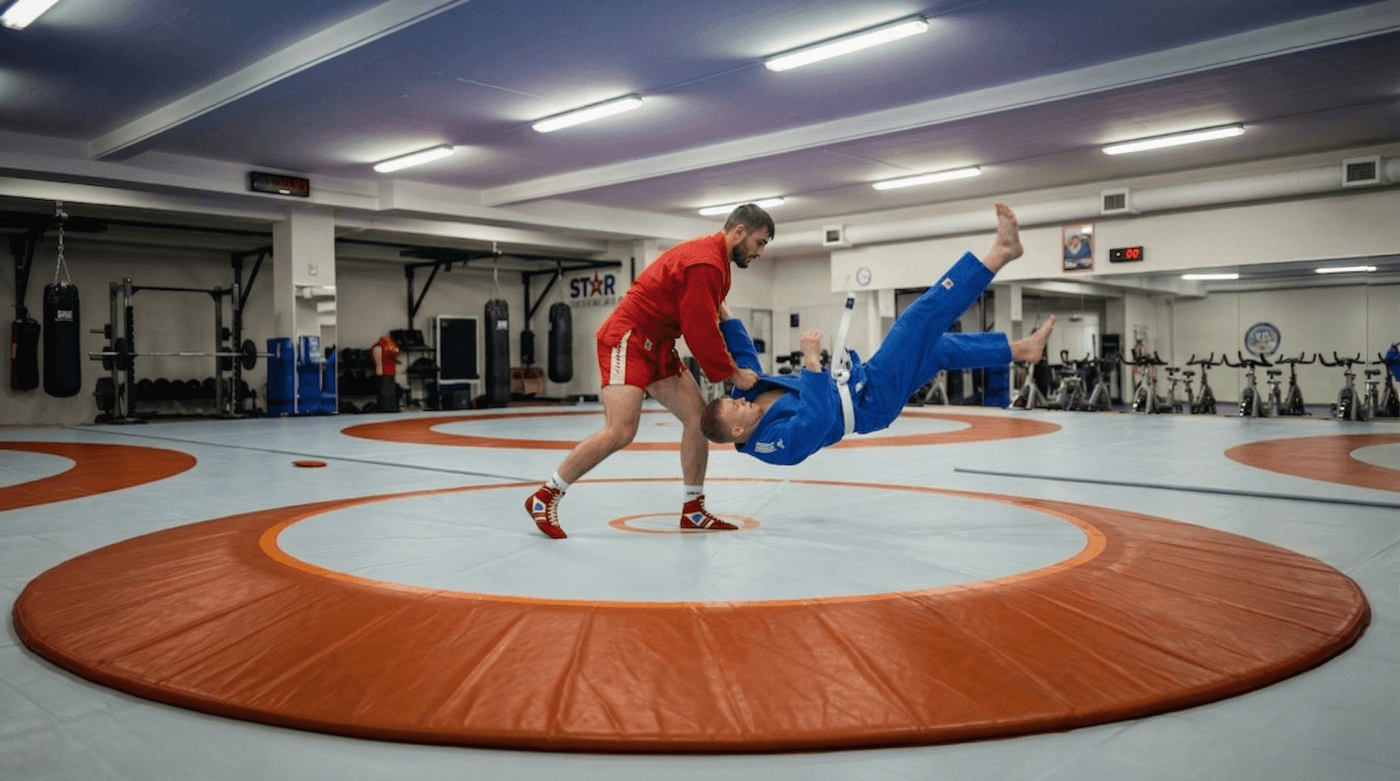
- Stand-up grappling is the language: clenching, pushing, pulling, sweeps, throws, and takedowns
- No submissions or chokes in standard SUJU MMA
This is where “center control” becomes a skill you can actually train like a system: stance, balance, pressure, grip fighting, angles, and ring awareness—before the chaos of striking is even on the table.
The Trigger Moment: Lose the Center, and the Fight Escalates
Here’s the defining mechanic:
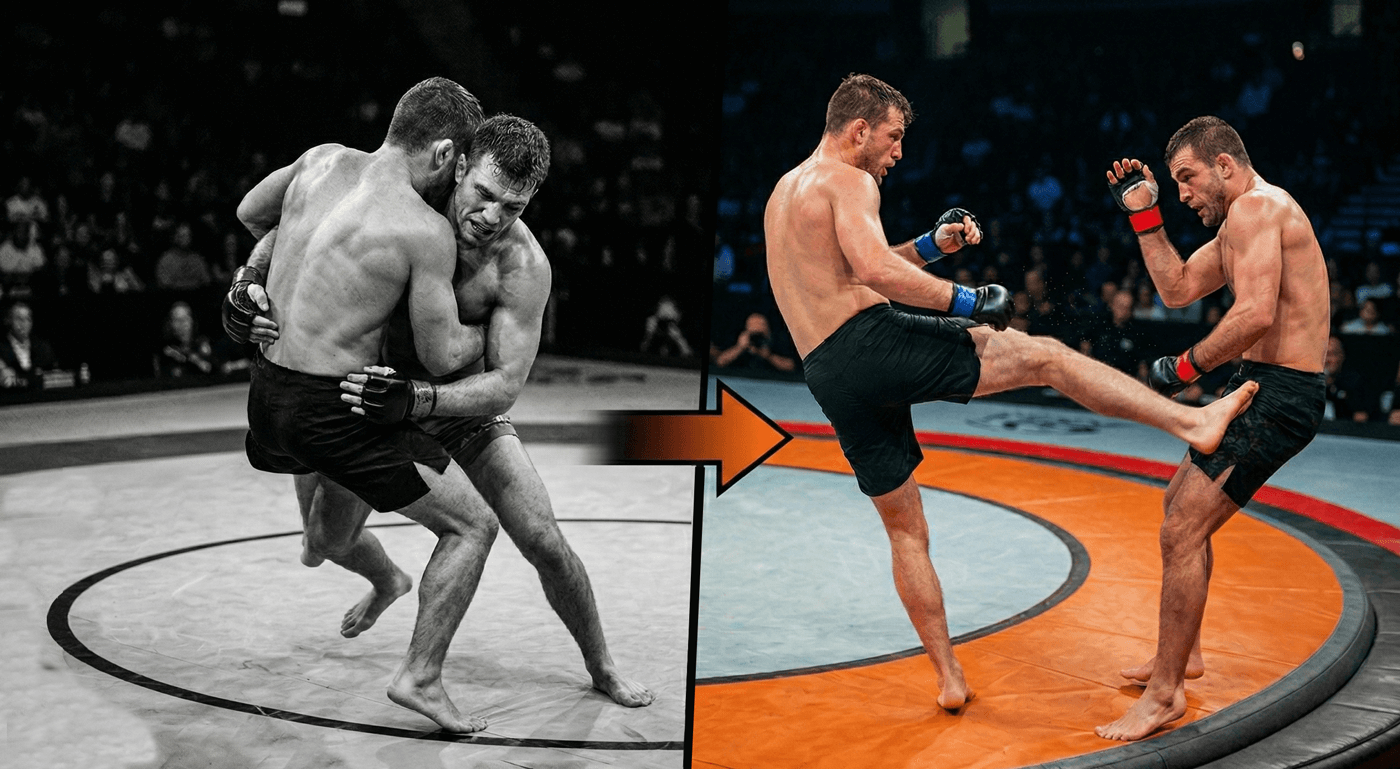
After a center ring-out (or a takedown), the referee announces “Fight,” and legal strikes and techniques become permitted. The rules explicitly call out that SUJU MMA changes the state of the fight mid-round.
That “Fight” call is the sport’s big switch. It’s the moment a coach can point to. It’s the moment a spectator understands instantly. And it’s the moment a fighter has to adapt; fast.
In other words:
- Win the center battle → you control when (and if) striking enters the round.
- Lose the center battle → you’ve activated the opponent’s full toolset.
The Second Phase: Strikes Open, But the Sport Still Stays “Standing-First”
Once “Fight” is called, the rules open up to a broad striking and clinch-takedown toolset (punches, elbows, kicks, knees, throws, sweeps, etc.).
But SUJU MMA is also intentionally designed to avoid turning into a long ground battle:
- Ground and pound is not permitted in standard SUJU MMA
- Striking a grounded opponent is prohibited (grounded defined in the rules)
- Submissions/chokes are not permitted in the standard ruleset (though SUJU variations are being tested)
That creates a very specific vibe: standing exchanges, clinch violence, throws, ring pressure, and explosive transitions without stalling on the mat.
Scoring, Ring-Outs, and Why the Sport Has “Big Swings”
SUJU MMA is currently described as a live point-based system with distinct scoring events tied to the sport’s core loop: takedowns, center ring-outs, and outer platform ring-outs.
At a high level, the rules lay out:
- 1 point: takedown before the first ring-out occurs
- 2 points: forcing an opponent out of the center ring (center ring-out)
- 3 points: takedown after the first ring-out occurs
- 5 points (or round end depending on event): forcing an opponent out of the platform outer ring (platform ring-out)
There are also procedural mechanics that keep the pace clean:
- After a platform ring-out or takedown, time stops and fighters reset to the center quickly (with penalties for not resetting).
And victory can come via points or stoppage (KO/TKO/ref stoppage), per the current rule outline.
How scoring could evolve as SUJU MMA grows
The rules page is clear that these rulesets include variations intended for pilot scrimmages, and the goal is to refine the sport through an advisory committee.
That matters, because SUJU’s scoring can evolve in ways that change the “feel” without changing the core loop. For example:
- Platform ring-outs could become more decisive (more events treating them as round-ending moments, which the rules already allow as an option).
- Point values can be tuned to reward what you want more of (more throws? more ring pressure? more clean ring-outs?).
- League variations (like fists-only “SUJU Tekken” or grappling-focused “SUJU Jitsu”) can share the same platform + center-control identity while optimizing different skills.
The important part: the scoring is attached to visible, understandable moments which is exactly what makes the format coachable and spectator-friendly.
Why SUJU MMA Feels Different Than Cage MMA
Most MMA happens inside boundaries that encourage “wall solutions” (stalling, pinning, wall-walking, fence grappling). SUJU MMA removes the cage and replaces it with a new kind of pressure: the ring itself becomes the constant threat.
Three big differences fighters notice immediately:
- The center matters more than position on a wall
Your “ring craft” isn’t about backing someone to a fence; it’s about owning the middle and forcing bad footing and exits. - The rules change mid-round
The shift from faceoff rules to “Fight” creates a tactical cliff edge. You can’t autopilot. - The action has built-in resets and swing moments
Ring-outs and resets create short, intense bursts. More like a series of high-stakes collisions than one long grind.
The Platform: Built to Reward Balance, Pressure, and Commitment
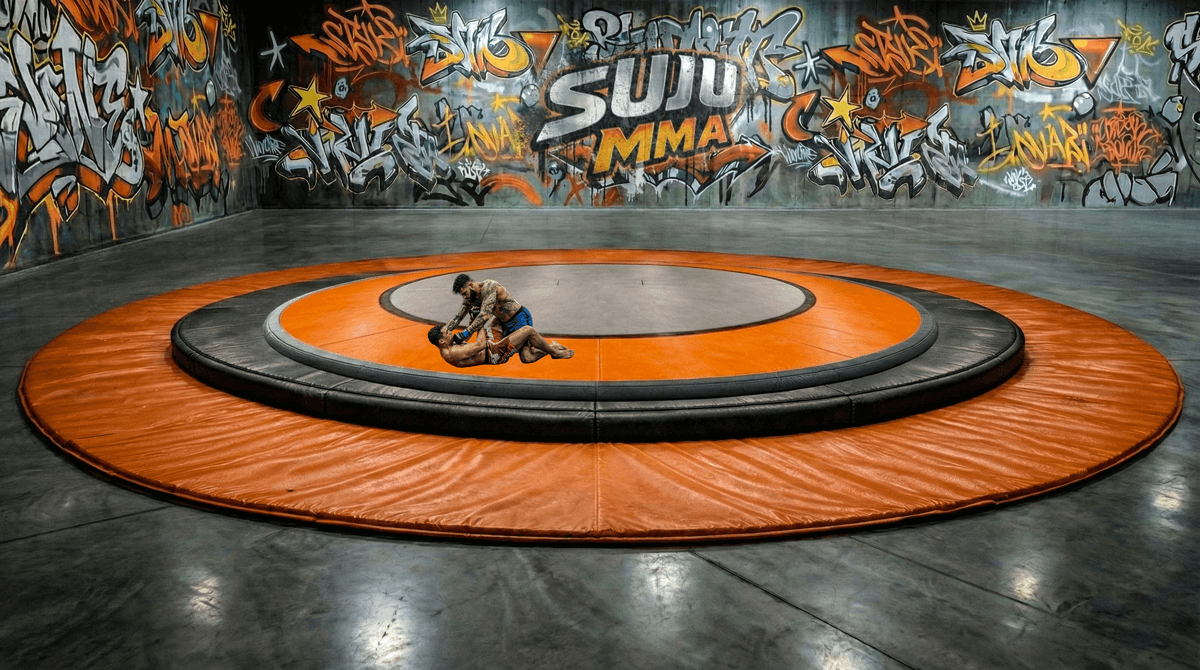
SUJU MMA is built around the “The Mound™”, which represents a change in environment.
And while the exact competition build is still being tested, the platform concept is consistent: a flat central zone and a sloped perimeter that punishes passive retreat and rewards proactive control.
From the current dimensions, the design concept includes:
- flat central platform (4m diameter)
- sloped perimeter (~2–5 degrees)
- outer diameter options (~6m or 7m)
- clearly marked starting lines
That geometry is not just aesthetics, it’s the sport’s “engine.”
Clear Systems, Clear Teaching Points
If you’re a coach, SUJU MMA gives you clean, drillable categories:
- Center control drills: stance integrity, level changes, shoulder pressure, lateral steps, anti-push posture
- Ring-out defense: hip turns, angle escapes, “catch balance” habits, and recovery footwork
- Trigger management: how to create the ring-out/takedown that opens strikes or how to avoid giving it away
- Short-burst intensity: repeated faceoffs + resets build conditioning that looks like a fight (not just cardio)
And if you’re a gym owner, SUJU MMA is easy to package:
- as a special rules sparring night
- as a spectator-friendly in-gym showcase format
- or as a way to attract cross-discipline athletes who want something new without asking them to abandon their base style.
Who SUJU MMA Is For
SUJU MMA is built for athletes who enjoy the clinch, pressure, and positional dominance but still want the danger and drama of striking.
It’s a strong fit for:
- Wrestlers who like control and drives
- Judoka / throwers who thrive in off-balancing exchanges
- Strikers who want clearer “go-time” moments
- MMA athletes who want a format where ring craft is not cage-dependent
And it’s a strong fit for gyms that want a new competitive ruleset to rally their community around. Become and early adopter and we will be sure to showcase your brand in the right light.
Get Involved: Pilot Sessions, Gym Demos, and the Rules Committee
SUJU MMA is actively recruiting pioneers: fighters, coaches, and gym owners. We would like you to help test and refine the format:
- Apply to join the Rules & Regulations Committee (the rules page explicitly frames this as the path to an official ruleset).
- Host a gym demo / pilot scrimmage (“Help Demo the Sport at Your Gym” is a featured pathway on the site).
- Stay in the loop for upcoming scrimmages and announcements via the site’s signup.
If you want to be early in a sport where the rules are still being shaped, this is that window.