Table of Contents
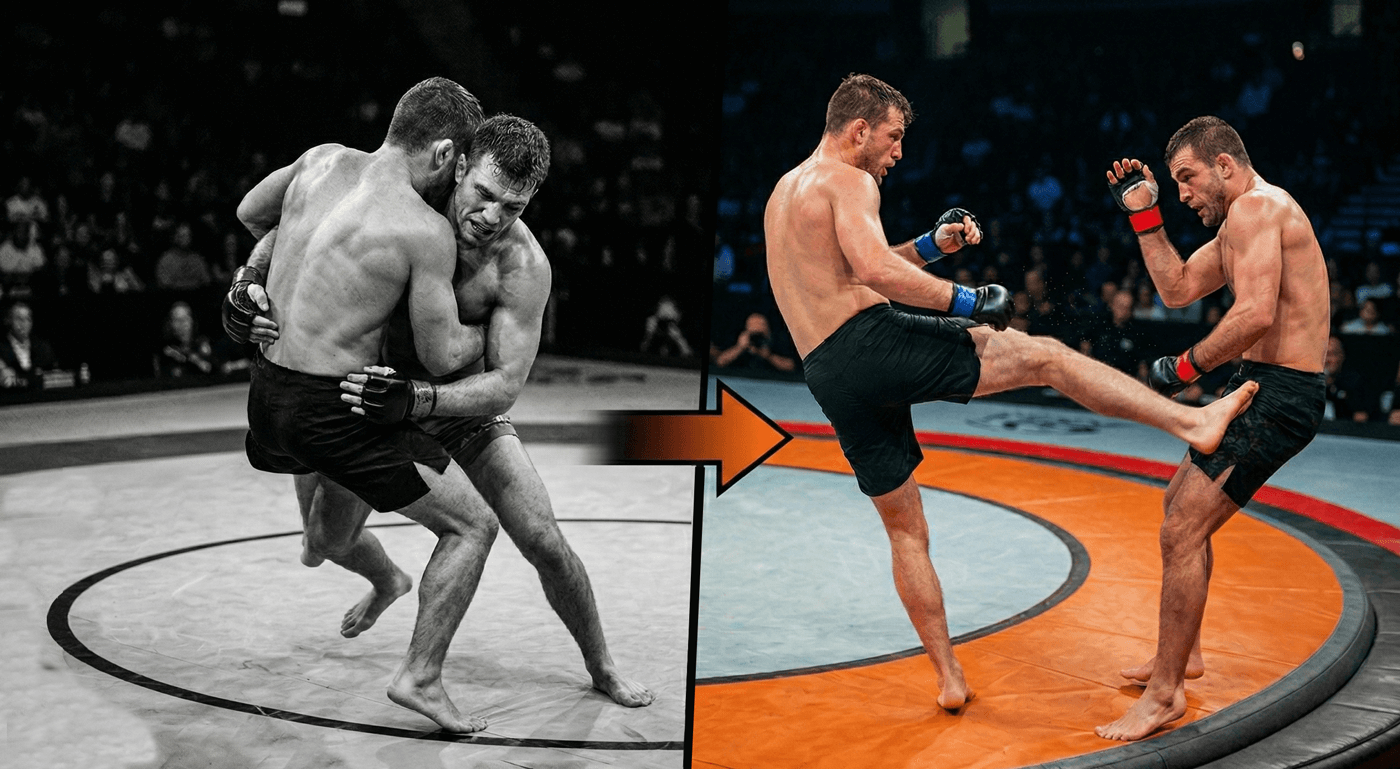
For judoka and samboists, SUJU MMA will feel familiar from the moment the match begins. The rules describe a grappling-driven face-off in the center ring where the primary objective is to push, pull, or throw the opponent out, resulting in a ring-out.
The Phases of Combat
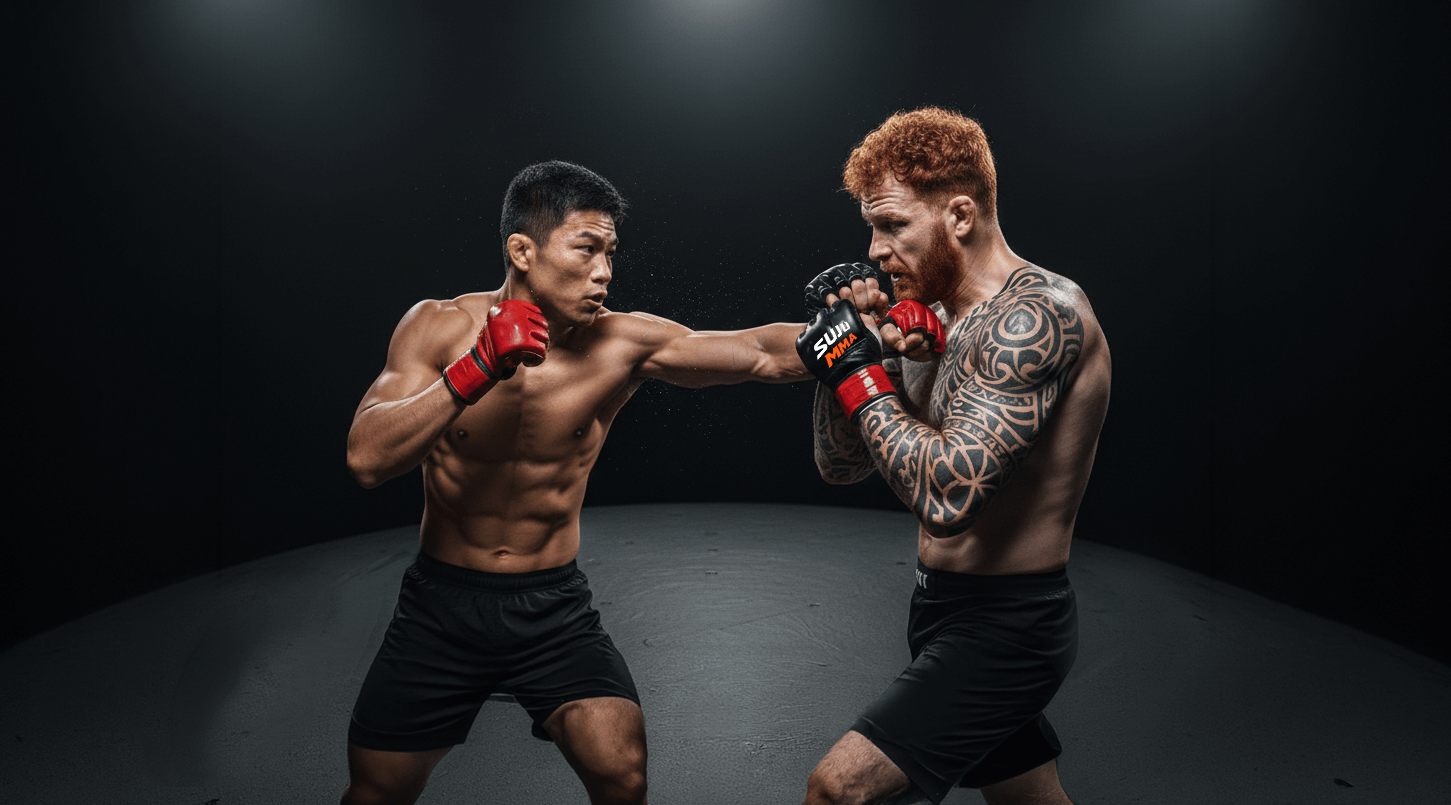
- The Opening Phase: No strikes are allowed. The battle is for center control, making it immediately relevant to athletes who understand balance, posture, kuzushi, and directional throwing.
- The Transition: While it begins with grappling, striking opens later in the round or after the first major strategic battle.
- The Surface: Unlike traditional mats, SUJU is built around The Mound™, a circular platform with a flat center and sloped outer ring designed to create “edge risk.”
Scoring & Strategy
The point system is designed to reward ring control and decisive finishes:
- 1 Point: Takedown (before the first ring-out)
- 2 Points: Center Ring-out
- 3 Points: Takedown (after the first ring-out)
- 5 Points: Platform Ring-out (often ending the round)
The Professional Edge: Judo brings a refined standard for controlled throws, while Sambo offers a practical scoring mindset. Early adopters should aim to translate these habits into a center-control, ring-pressure format rather than copying them wholesale.
What counts as a scoring throw in SUJU MMA?
In SUJU, a throw or takedown is measured by its consequence, not just its form. It matters when it produces a scoreable event, advances ring position, or forces the opponent toward the edge.
The Scoring Breakdown
- Before the First Center Ring-Out: A takedown is worth 1 point.
- After the First Center Ring-Out: A takedown anywhere on The Mound™ is worth 3 points.
- Simultaneous Action: If a center ring-out and a takedown happen at the same time, 3 points are awarded.
Why This Matters for Judo & Sambo Athletes
The “standard” for a good throw changes when you move from the mat to the platform:
- In Judo/Sambo: The focus is on clear technique, control, and the quality of the landing (e.g., Ippon).
- In SUJU MMA: The focus is on the result. Did the action create a clear takedown, a ring-out, or a bigger scoring sequence?
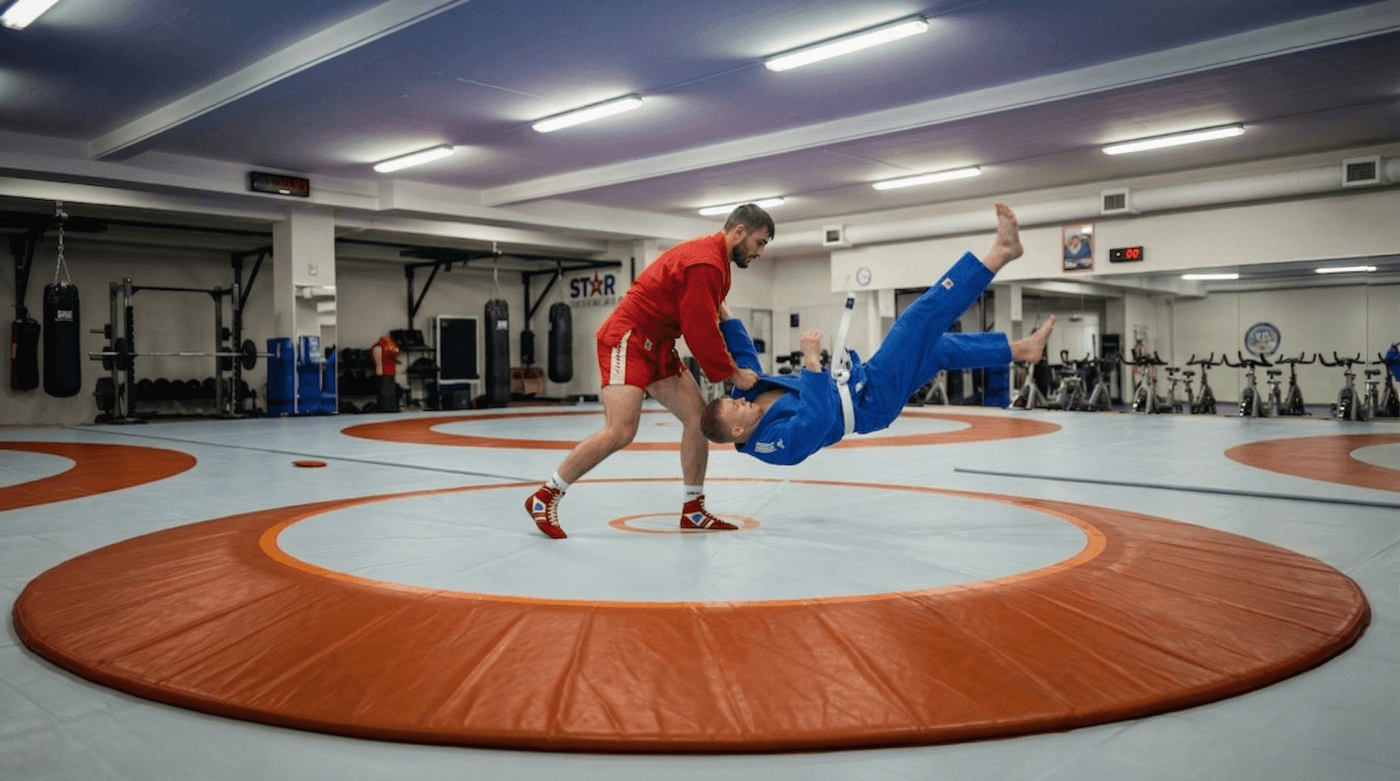
This makes compact, visible, and referee-friendly throws, those that clearly put the opponent’s back or hips to the surface, especially valuable for scoring
The “Stale Center” Exception: What You Need to Know
To keep the momentum high, SUJU includes a structural rule for the opening phase:
- The Standstill: If neither fighter produces a center ring-out in a reasonable time, the referee will command you to “pick up the pace.”
- The “FIGHT” Command: If action doesn’t accelerate, the referee calls “FIGHT.”
- The Shift: This immediately opens up all legal strikes. No points are awarded for the transition, but the match continues as if a ring-out had already occurred (meaning takedowns are now worth 3 points).
The Grappling DNA: Judo & Sambo Contributions
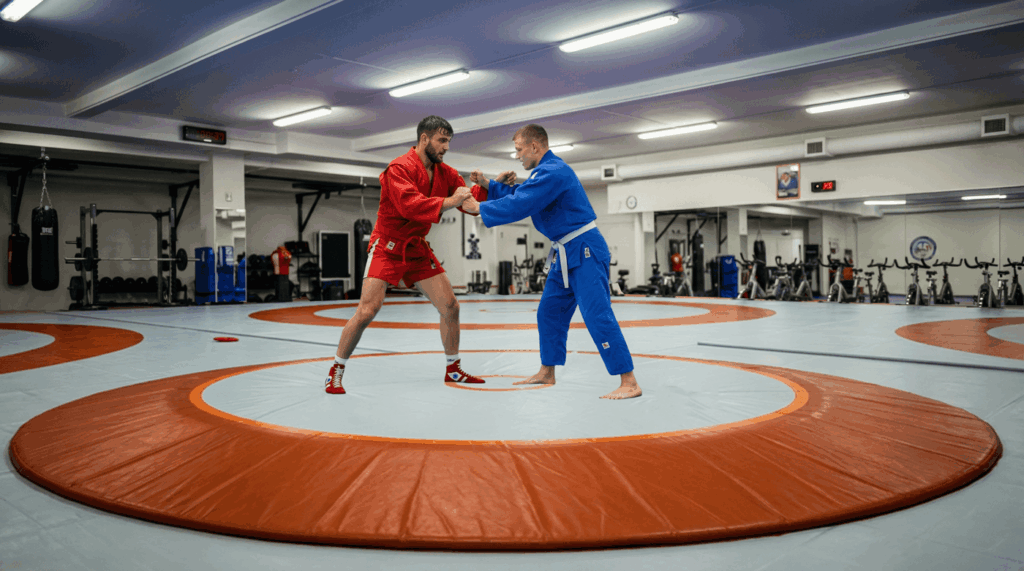
SUJU MMA isn’t just “MMA on a hill”; it is a sport that prizes the technical precision of Judo and the postural efficiency of Sambo.
What Judo Contributes: Quality & Continuity
- The “Ippon” Standard: Even without an official Ippon score, SUJU values throws with speed, force, and control. This prevents “chaotic” follow-ups and keeps the landing safe.
- Flow over Friction: Judo’s insistence on continuity of action is vital for the circular platform. Success comes from the smooth transition from grip fighting to a posture break (kuzushi) to a finish.
What Sambo Contributes: Balance & Clarity
- The Upright Attacker: Sambo rewards athletes who stay standing during a throw. In SUJU, staying upright preserves your ring orientation and allows you to immediately press the “edge risk.”
- Decisiveness: Sambo’s clear distinction between standing actions and grounded outcomes eliminates “muddy” gray zones for referees.
High-Percentage Throws for The Mound™
Because of the sloped surface and the Center Ring mechanics, “amplitude” (height) is less important than directional pressure.
- Foot Sweeps (De-ashi-barai): The highest-percentage move. As an opponent steps back to recover from center pressure, their weight transition creates the perfect window for a sweep.
- Inside/Outside Trips: These require minimal “travel distance.” They are ideal when an opponent is pinned near the slope and struggling with stance recovery.
- Snap-Down Chains: Winning head position and dragging posture forward forces the opponent to over-correct, setting up an easy trip toward the boundary.
- Compact Hip Throws: Large, “load-up” throws are risky without a gi. Focus on shortened, redirective versions that prioritize rotation over lift.
Safety & Landing Standards
A score only counts if it is executed safely. SUJU strictly prohibits:
- Spiking/Pile-driving: Any throw intended to land an opponent on their head or neck.
- Grounded Strikes: Once a takedown occurs, the action resets. There is no ground-and-pound in standard SUJU. (Review the different variations on the Rules Page.)
- Surface Awareness: High-impact slams are strictly for the Padded Competition Mat; they are not permitted in “Dirt Mound” competitions.
The 15-Second “SUJU Translation” Drill
Use this drill to help traditional grapplers adapt to the SUJU loop:
- 0–5 Seconds (The Battle): High-intensity grip fighting/hand fighting in the 4m center.
- 5–10 Seconds (The Pressure): Force the opponent to take one meaningful recovery step toward the slope.
- 10–15 Seconds (The Score): Execute a clean action (Foot sweep, trip, or snap-down).
Goal: This isn’t about cardio; it’s about sequence discipline. Learn to time your throw based on the opponent’s reaction to the ring boundary.
Note to Athletes and Coaches
SUJU MMA is currently in its active development and testing phase. The rules and scoring logic presented here are part of a living concept designed to be refined by the combat sports community. If you are interested in contributing, the sport is actively recruiting across several areas. The highest current priority is experienced combat sports officials — licensed referees, judges, and people with athletic commission or sanctioning body experience — who can help make rules enforceable in real bouts. Alongside that, SUJU is seeking coaches and technical experts from wrestling, judo, sambo, and MMA backgrounds who can identify what works strategically and what creates unsafe loopholes.
Learn how to get involved at sujumma.com/rule-advisory-committee/ and sujumma.com/become-suju-fighter/ .
Sources
- SUJU MMA Rules & Variations — sujumma.com/suju-rules/
- SUJU MMA FAQs — sujumma.com/faqs/
- SUJU MMA Rule Advisory Committee — sujumma.com/rule-advisory-committee/
- Help Test SUJU MMA — sujumma.com/become-suju-fighter/
- International Judo Federation, Detailed Explanation of the IJF Judo Refereeing Rules / Evaluation of the points — rules.ijf.org
- International Sambo Rules (FIAS / Combat Sambo rules PDF): https://sambo.sport/upload/iblock/60e/60ea93c67f9eab02474addcce2f41b2f.pdf
- Sambo Competitions Rules summary result: https://sambo.sport/upload/iblock/60e/60ea93c67f9eab02474addcce2f41b2f.pdf